
Understanding Your Car’s AC System: Why is My Car AC Not Cold?
Table of Contents:
- How Your Car’s Air Conditioning System Works
- Top Reasons Your Car AC Isn’t Blowing Cold Air
- Basic Car AC Troubleshooting You Can Do at Home
- When to Seek Professional Car AC Repair in South Jordan
- GT Automotive’s Expert Car AC Diagnosis and Repair Services
- Preventative Maintenance for Your Car’s AC System
- Frequently Asked Questions
- Don’t Suffer in Silence: Get Your Car AC Fixed Today!
How Your Car’s Air Conditioning System Works
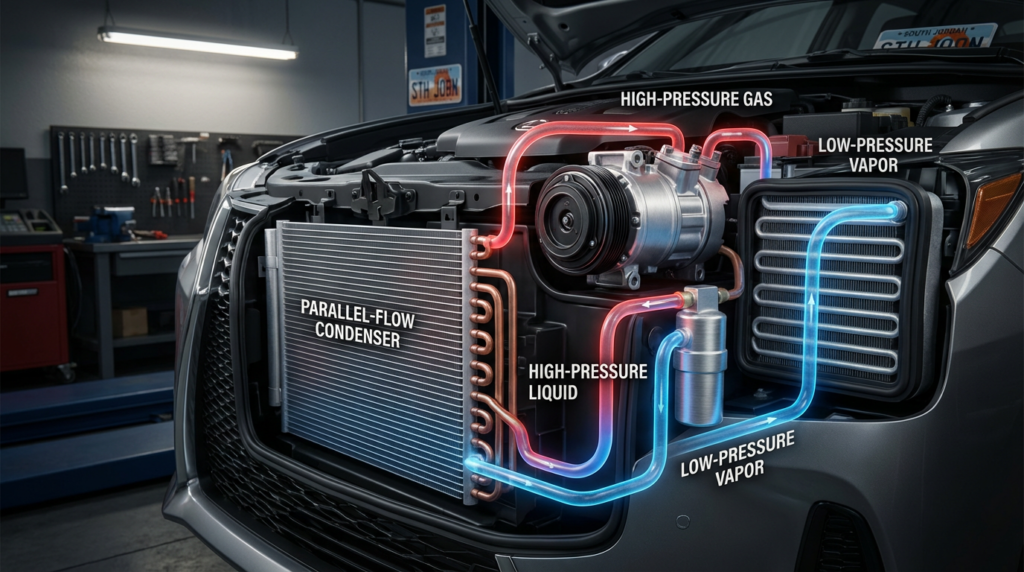
Your car’s air conditioning does not create cold; it removes heat. Think of it as a specialized refrigerator for your cabin, using a closed-loop system to transfer thermal energy from inside your vehicle to the outside air. The process relies on the continuous phase change of a chemical called a refrigerant, cycling it between a gas and a liquid to absorb and release heat with remarkable efficiency.
This cycle is what transforms a sweltering Utah summer day into a cool, comfortable drive. Understanding its key players is the first step in diagnosing why it might fail. Every part must work in perfect sequence to restore proper operation.
Key Components of Your Car’s AC
- Refrigerant (Freon): The lifeblood of the system. This chemical substance has a very low boiling point, allowing it to absorb heat from your cabin and vaporize.
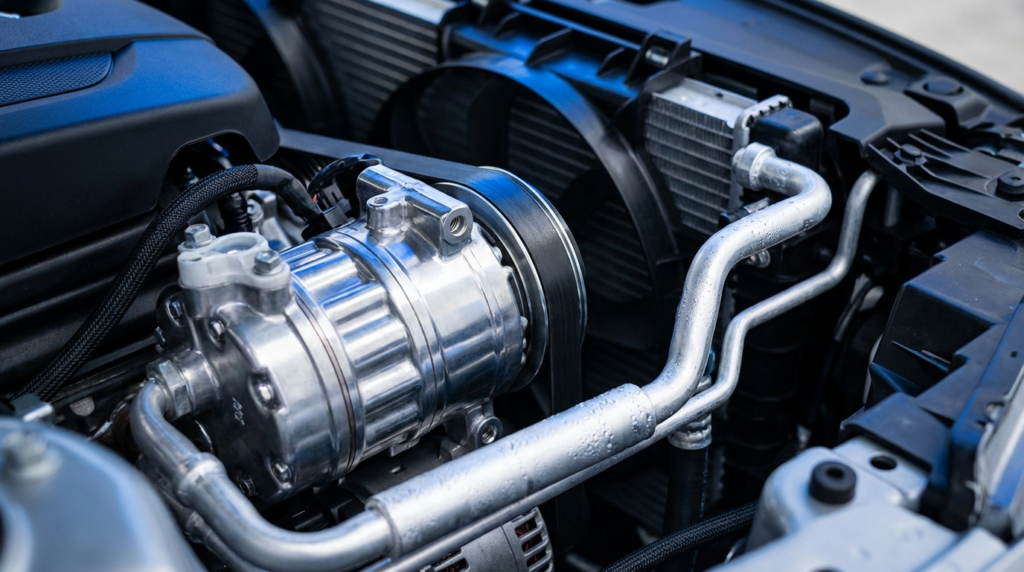
- Compressor: The heart of the system. Driven by an engine belt, this pump pressurizes the gaseous refrigerant, raising its temperature significantly before sending it to the condenser.
- Condenser: A small radiator, usually in front of the engine’s main radiator. As air flows over its fins, it draws heat from the high-pressure refrigerant, cooling it and condensing it back into a liquid.
- Evaporator: Another small radiator, but located deep inside your dashboard. The now-liquid refrigerant enters the evaporator at low pressure, causing it to boil and turn back into a gas very quickly. This rapid evaporation absorbs immense heat from the cabin air being blown over it, delivering the cold air you feel from your vents.
Top Reasons Your Car AC Isn’t Blowing Cold Air
An AC system failure almost always traces back to one of five core issues. While a simple loss of refrigerant is the most frequent culprit, a precise diagnosis is essential because the wrong fix can cause more harm than good. In our 40+ years of service, we’ve seen how accurate identification of the root cause separates a lasting repair from a temporary patch.
Low or Leaking Refrigerant (Freon)
This is the most common reason your car’s AC feels weak or blows warm air. Your vehicle’s AC is a sealed system, meaning the refrigerant doesn’t get “used up” like gasoline. If it’s low, there is a leak. It could be a pinhole in a hose, a cracked O-ring, or a failing seal in the compressor. Simply adding more refrigerant without finding and fixing the leak just kicks the can down the road.
Faulty AC Compressor
A failing compressor brings the entire cooling process to a halt. The compressor clutch, which engages the pump, can wear out and fail to activate. Internally, seals and pistons can fail, preventing the compressor from building the pressure needed to circulate refrigerant. You might hear loud grinding or squealing when you turn the AC on, which is a definitive sign of compressor trouble.
Electrical System Malfunctions
Modern vehicles, especially the luxury and Japanese models we specialize in, use complex electrical controls for the AC. A blown fuse, a bad relay, or a failed pressure switch can prevent the compressor clutch from engaging. Our Lexus-factory-trained technicians use advanced diagnostics to trace these circuits, because the issue is often not mechanical at all but a simple broken connection in a complex wiring harness.
Clogged Condenser or Evaporator
The condenser sits at the very front of your car and is vulnerable to road debris, dust, and grime. If its fins get clogged, air can’t flow through to remove heat from the refrigerant, severely reducing cooling performance. Likewise, a dirty cabin air filter can clog the evaporator, which not only restricts airflow but can also trap moisture and cause a musty smell. Knowing how often to change your cabin air filter is key to preventing this.
Bad Blower Motor or Fan Issues
Sometimes the air is cold, but it just isn’t moving. If you can feel a faint chill near the vents but have no real airflow, the problem is likely the blower motor or its resistor. This fan is responsible for pushing the cold air from the evaporator into your cabin. A failed motor, a faulty resistor pack (which controls fan speed), or even a blown fuse can leave you with working AC but no way to feel it.
Basic Car AC Troubleshooting You Can Do at Home
While most AC repairs require specialized tools and training, you can perform a few initial checks to gather information. This helps you have a more informed conversation with your technician. However, proceed with caution and never open the sealed refrigerant lines yourself.
Checking for Obvious Issues
With the engine off, pop the hood and visually inspect the AC condenser at the front of the vehicle. Look for any leaves, plastic bags, or heavy buildup of dirt blocking the fins. With the engine running and AC turned to max, carefully observe the front of the AC compressor. You should see the center part of the pulley (the clutch) engage and spin with the belt. If it doesn’t, you may have an electrical issue or be very low on refrigerant.
Listening for Unusual Noises
Turn on your AC and cycle through the fan speeds. Listen for any abnormal sounds. A continuous squeal could point to a slipping belt. A loud grinding or rattling noise that starts only when the AC is on points directly to a failing compressor. A clicking sound from under the dashboard might indicate an issue with the blend doors that direct airflow.
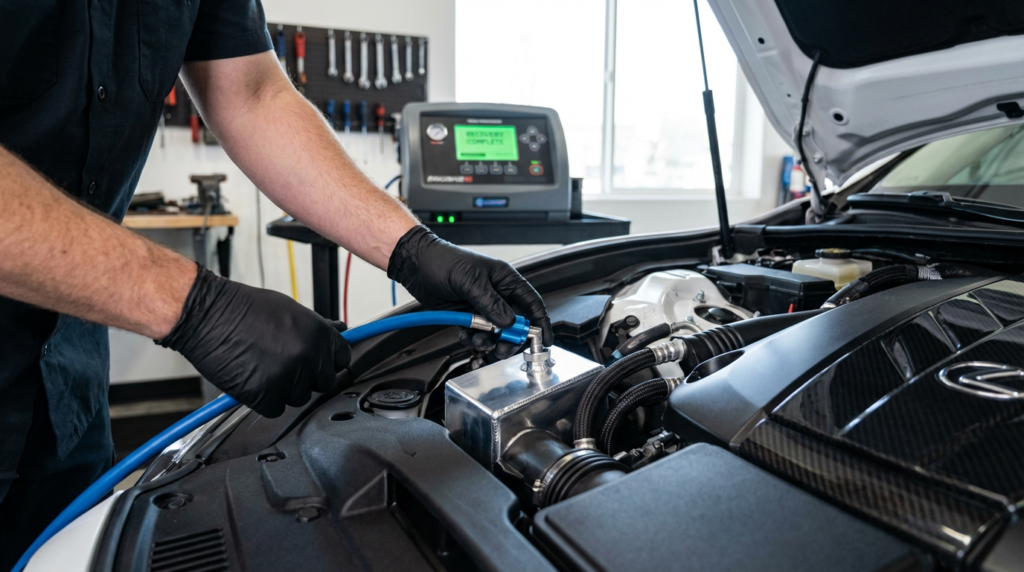
Pro Tip: Avoid DIY AC recharge kits. While tempting, these kits can easily do more harm than good. Overcharging the system can damage the compressor, and many kits contain sealants that can clog sensitive components. Professional service involves recovering the old refrigerant, pulling a vacuum to remove moisture, and refilling the exact weight specified by the manufacturer—a process that is impossible with a can from the auto parts store.
When to Seek Professional Car AC Repair in South Jordan
It’s time to call a professional when simple visual checks don’t reveal the problem or when symptoms point to a serious component failure. Intermittent cooling, strange noises from under the hood, visible oily residue around AC line fittings, or a system that simply won’t engage are all signs that you need expert diagnosis. Ignoring these warnings can lead to a cascading failure in which one faulty part takes out other expensive components.
Driving in South Jordan without a functioning AC isn’t just uncomfortable; it can be a safety issue on hot summer days. An ASE-Certified technician has the training and equipment, like refrigerant leak detectors and manifold gauges, to pinpoint the exact failure safely and accurately. For owners of specialized Japanese or vintage cars, this level of expertise is critical to protect your investment.
Ready for a proper diagnosis? Call GT Automotive to schedule your AC inspection today.
GT Automotive’s Expert Car AC Diagnosis and Repair Services
At GT Automotive, we combine dealership-level expertise with the honest, transparent service of an independent shop. For over 40 years, customers have trusted us because we find the real problem, explain it clearly, and perform repairs that last. This approach is why customers who come for a simple service check often stay with us for decades.
Complete ‘Car AC Not Blowing Cold Air Diagnosis.’
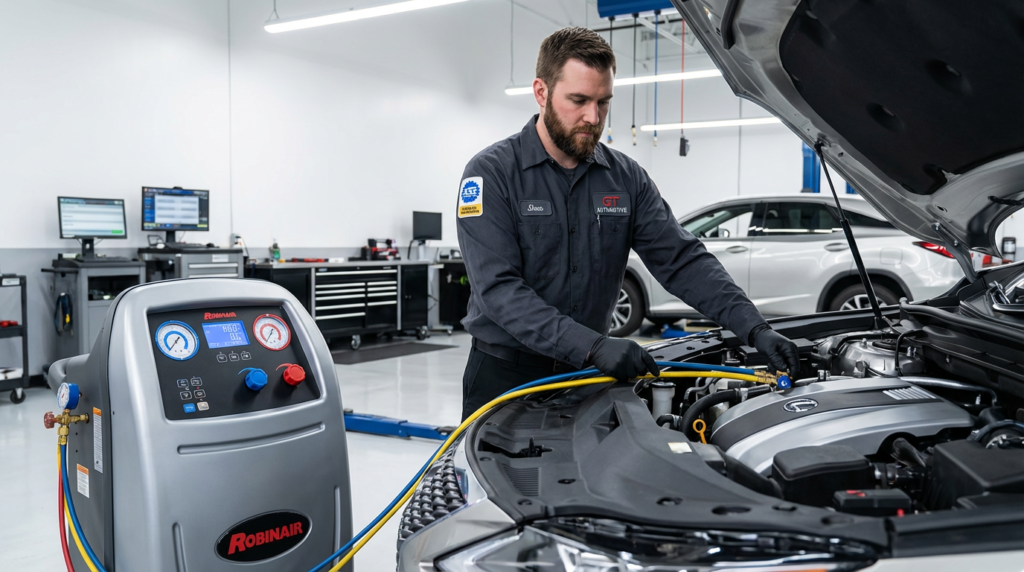
Our process begins with advanced computer diagnostics to check for any trouble codes from your vehicle’s climate control module. We then connect a professional gauge set to measure high-side and low-side pressures, giving our master mechanics a clear picture of the system’s health. Using fluorescent dye and specialized electronic leak detectors, we methodically inspect every inch of the system—from the compressor seals to the evaporator core—to find the true source of your refrigerant leak. This guarantees we replace only what’s broken.
Professional ‘Heating & A/C Service’ for Lasting Comfort
Once diagnosed, our ASE-Certified technicians perform the necessary repairs using high-quality parts that meet or exceed OEM specifications. Whether it’s replacing a compressor on a classic Oldsmobile or sourcing a rare sensor for an imported Lexus, we have the experience to do it right. All our repairs are backed by a complete warranty, giving you peace of mind that your comfort is protected for the road ahead.
Preventative Maintenance for Your Car’s AC System
The best repair is the one you never have to make. You can extend the life of your AC system with a few simple habits. First, run your air conditioner for at least 10 minutes once a month, even during the winter. This circulates the refrigerant and its embedded oil, keeping the system’s seals lubricated and preventing them from drying out and cracking.
Second, replace your cabin air filter regularly. A clean filter ensures strong airflow and reduces the strain on your blower motor. Finally, consider a pre-season trip inspection in the spring, which allows a technician to check refrigerant levels and system performance before the summer heat arrives. This proactive step can catch small leaks before they become major, expensive failures.
What is the $5,000 AC rule? This is a general guideline used in the auto industry to help decide if a major repair is worth it. It suggests that if the cost of a repair is more than 50% of the car’s market value, you should reconsider. However, for the vintage, luxury, and well-maintained Japanese vehicles we service, this “rule” often doesn’t apply. The value of a reliable, cherished vehicle goes beyond a simple market price.
Frequently Asked Questions
Can DIY refrigerant kits damage my car?
Yes. These kits cannot measure the exact amount of refrigerant needed. Overcharging the system puts immense strain on the compressor, leading to premature failure. Additionally, many contain sealants that can clog the orifice tube or expansion valve, turning a simple repair into a system-wide contamination issue. For compliance and safety, this job is best left to technicians with EPA 609 certification.
My AC smells musty. What causes that?
That classic "gym sock" smell is typically caused by mold or mildew growing on the evaporator core in your dashboard. The evaporator gets cold and collects condensation, and if that moisture doesn't drain properly, it becomes a breeding ground for bacteria. A dirty cabin air filter can contribute to this. We offer services to clean the evaporator and ventilation system to eliminate the odor at its source.
Is a weak AC always a refrigerant leak?
Not always. While a leak is the most common cause, a weak AC can also result from a failing compressor that isn't building enough pressure, a clogged condenser that can't release heat, or even a blend door actuator that is stuck and mixing in warm air from the heater core. This is another reason professional diagnosis is so important to avoid replacing the wrong parts.
Can a working AC help with allergies?
Absolutely. Your car's cabin air filter is designed to trap dust, pollen, and other pollutants before they enter your car. Running your AC system with recirculation on and a clean filter creates a sealed environment that can significantly reduce the allergen count inside your vehicle, providing relief during Utah's allergy season.
Don’t Suffer in Silence: Get Your Car AC Fixed Today!
A weak or broken car air conditioner makes every drive miserable. You don’t have to endure another sweltering commute. At GT Automotive, we provide the dealership-level diagnostics and master-level expertise needed to restore your comfort quickly and correctly.
From pinpointing elusive leaks in a classic sports car to servicing the advanced climate control systems in a new Lexus, we have the skill and technology to get it right. Our honest assessments, transparent pricing, and warranty-backed repairs have made us South Jordan’s trusted choice since 1980.
Stop guessing what’s wrong. Contact GT Automotive today to schedule a complete AC performance test and get a definitive solution.